
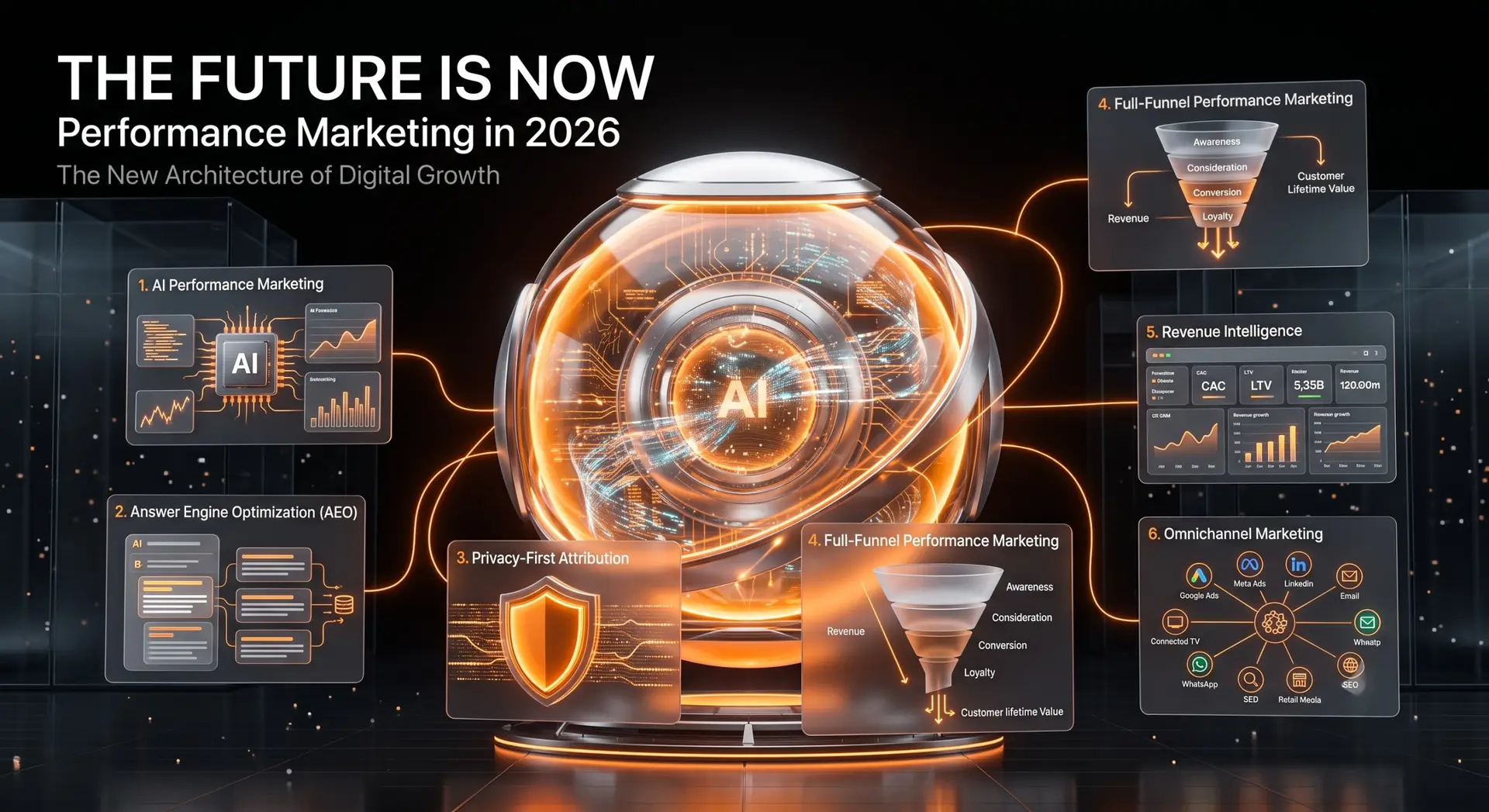
Performance marketing is no longer merely a tactical channel within a broader advertising strategy; it is the fundamental revenue intelligence system driving modern corporate growth1. In the early days of online advertising, digital strategy was heavily reliant on mass exposure, basic demographic targeting, and rudimentary impression-based metrics3. Today, the ecosystem has undergone a profound structural transformation. Vanity metrics have been entirely replaced by a strict demand for accountability, transparency, and measurable Return on Ad Spend (ROAS)4.
At DigiLink Technologies, an elite digital marketing agency based in Mumbai, we recognize that the digital landscape of 2026 demands a complete reimagining of how brands acquire, retain, and monetize customers6. The modern marketing environment is defined by the convergence of artificial intelligence (AI), the explosion of retail media networks, and a decisive, industry-wide shift toward privacy-driven, first-party data strategies4.
This flagship report serves as a definitive blueprint for business owners and marketing executives. It synthesizes decades of advertising evolution—from foundational reach and frequency concepts to the cutting-edge realities of AI automation, privacy-first attribution, and rigorous B2B SaaS unit economics—providing a comprehensive roadmap for dominating the digital marketplace in 2026 and beyond.
The Macroeconomic Landscape: India’s Digital Dominance
The Indian advertising market has crossed a structural threshold, decisively cementing digital media as the primary engine of commercial growth. By the end of 2025, digital advertising officially overtook traditional television, a monumental shift driven by deeper internet penetration, mobile-first consumption, and Gen-Z-led content behaviors10.
Exponential Market Growth and Financial Realities
Recent macroeconomic analyses reveal that the Indian advertising market reached a staggering ₹1,55,105 crore in 2025, representing a 12% year-over-year growth12. Digital advertising expenditure alone hit ₹93,156 crore (a 22% increase), while traditional legacy media saw a stagnation or slight decline12. Projections for 2026 indicate the total advertising market will reach ₹1,74,605 crore, with digital’s share climbing to an unprecedented 64% to 70%10.
Table 1: India Advertising Market Sizing & Projections (FY2025 – FY2027)
Advertising Sector | 2025 (Actual) | 2026 (Projected) | 2027 (Forecast) |
|---|---|---|---|
Total Advertising Spend | ₹1,55,105 crore | ₹1,74,605 crore | ₹2.01 lakh crore |
Digital Advertising Spend | ₹93,156 crore | ₹98,034 – ₹1.11L crore | ₹1,40,001 crore |
Digital Market Share | 60% | 64% | 68% – 70% |
Linear TV Spend | ₹32,855 crore | Flat | Declining to 15% share |
Connected TV (CTV) | ₹6,000 crore | ₹8,000 crore | High Double-Digit Growth |
Quick Commerce Ad Spend | ₹4,000 crore | ₹6,000 crore | +50.0% YoY |
Data synthesised from leading 2026 digital marketing industry reports10.
The Three Engines Reshaping Media Allocation
The explosive growth of the digital sector is not merely a consequence of more users coming online; it is being actively driven by three distinct structural forces that have fundamentally altered how advertisers allocate budgets12:
- The Evolution of the Large Screen (Connected TV): While linear television ad volumes dropped by 10% due to FMCG budget cuts, video budgets have not left the television format; they have migrated to Connected TV (CTV)12. CTV advertising doubled in 2025 and is projected to hit ₹8,000 crore in 202612. Brands are leveraging CTV to execute performance-driven, targeted video campaigns that merge the high-impact emotional resonance of traditional TV with the precise, real-time attribution of digital media12.
- Retail Media and Quick Commerce: The convergence of media and commerce has birthed a massive “media-to-money” engine12. Advertising on e-commerce and retail media networks reached ₹17,601 crore by late 202510. More notably, quick commerce platforms (such as Blinkit, Zepto, and Swiggy Instamart) saw their ad revenues explode by 202%12. Performance marketers value these platforms because they offer unparalleled proximity to the point of purchase, utilising rich first-party data to intercept consumers precisely when intent is highest13.
- MSME Digital Adoption: Micro, Small, and Medium Enterprises (MSMEs) are no longer minor players; they contributed ₹35,814 crore to digital ad spend in 2025 (up 21%) and are projected to hit ₹42,976 crore in 202612. The democratisation of AI tools and programmatic platforms allows millions of local Indian businesses to execute sophisticated, performance-led marketing strategies, actively competing with enterprise-level brands for prime ad inventory12.
The Evolution of Targeting: From Cookies to Context and Consent
To understand the sophistication of 2026 performance marketing, one must look at the evolution of audience targeting. Historically, the digital advertising playbook relied heavily on broad demographic profiling and the unchecked use of third-party cookies to track users across the web3. The foundational concepts of online advertising established seven primary targeting methodologies: Demographic, Contextual, Behavioural, Geographic, Daypart, Affinity, and Purchase-Based3.
In 2026, these seven pillars remain critical, but they have been entirely re-engineered to comply with global privacy mandates and the shift toward first-party data9:
- Demographic and Geographic Targeting: Originally reliant on basic IP addresses and self-reported survey data, geo-targeting is now powered by hyper-local, real-time mobile GPS data and AI3. In Mumbai, for example, hyper-local SEO and location-based keywords have become the standard for brick-and-mortar retail and service businesses seeking foot traffic16.
- Contextual Targeting’s Renaissance: As surveillance-style tracking and third-party cookies fade into obsolescence, contextual targeting has made a massive comeback9. Rather than tracking the identity of the user, modern contextual targeting uses AI to analyse the semantic meaning of the content being consumed3. Brands place ads in highly relevant environments (e.g., placing high-performance server ads on a developer forum) without relying on personal data, driving incredibly high engagement through sheer relevance9.
- Behavioural and Purchase-Based Targeting: Previously, ad networks used third-party cookies to watch users navigate from site to site3. Today, behavioural targeting is strictly reliant on first-party and zero-party data2. By capturing authenticated data directly from owned websites, CRM systems, and loyalty programs, brands can utilise AI to build predictive look-alike audiences that are both highly accurate and entirely privacy-compliant2.
- Daypart and Affinity Targeting: The timing of an ad matters immensely. Just as traditional radio utilised “drive time,” modern algorithms dynamically adjust bids based on when a specific user is most likely to convert3. Affinity marketing has evolved into deep community engagement, targeting highly specific niches on platforms like Reddit, Discord, and niche retail networks3.
At DigiLink Technologies, our campaigns leverage these modernised targeting pillars to ensure that every rupee spent is directed exclusively at highly qualified, high-intent audiences6.
Artificial Intelligence: Industrialising Optimisation and Shifting Search
Artificial Intelligence (AI) has transitioned from an experimental buzzword to the mandatory infrastructure of performance marketing. By 2026, AI handles roughly 90% of real-time bidding, budget pacing, and dynamic creative adjustments across all major ad networks5.
Automated Bidding and Predictive Media Buying
The days of manual bid adjustments and gut-feeling campaign management are over. Human bias and slow reaction times lead directly to higher cost-per-acquisition (CPA) and inconsistent scaling2. Today, automated bidding protocols evaluate millions of data signals per second, allocating budgets predictively based on conversion probability modeling2.
When properly structured with clean conversion data and accurate attribution signals, AI-driven management routinely delivers a 15% to 25% increase in ROAS and operates at up to 2.9x higher efficiency than manual setups2. The role of the performance marketer has shifted from pulling levers to acting as an algorithmic architect—feeding the AI clean data, defining strict business outcomes, and guiding creative strategy2.
The Paradigm Shift: From SEO to Answer Engine Optimisation (AEO)
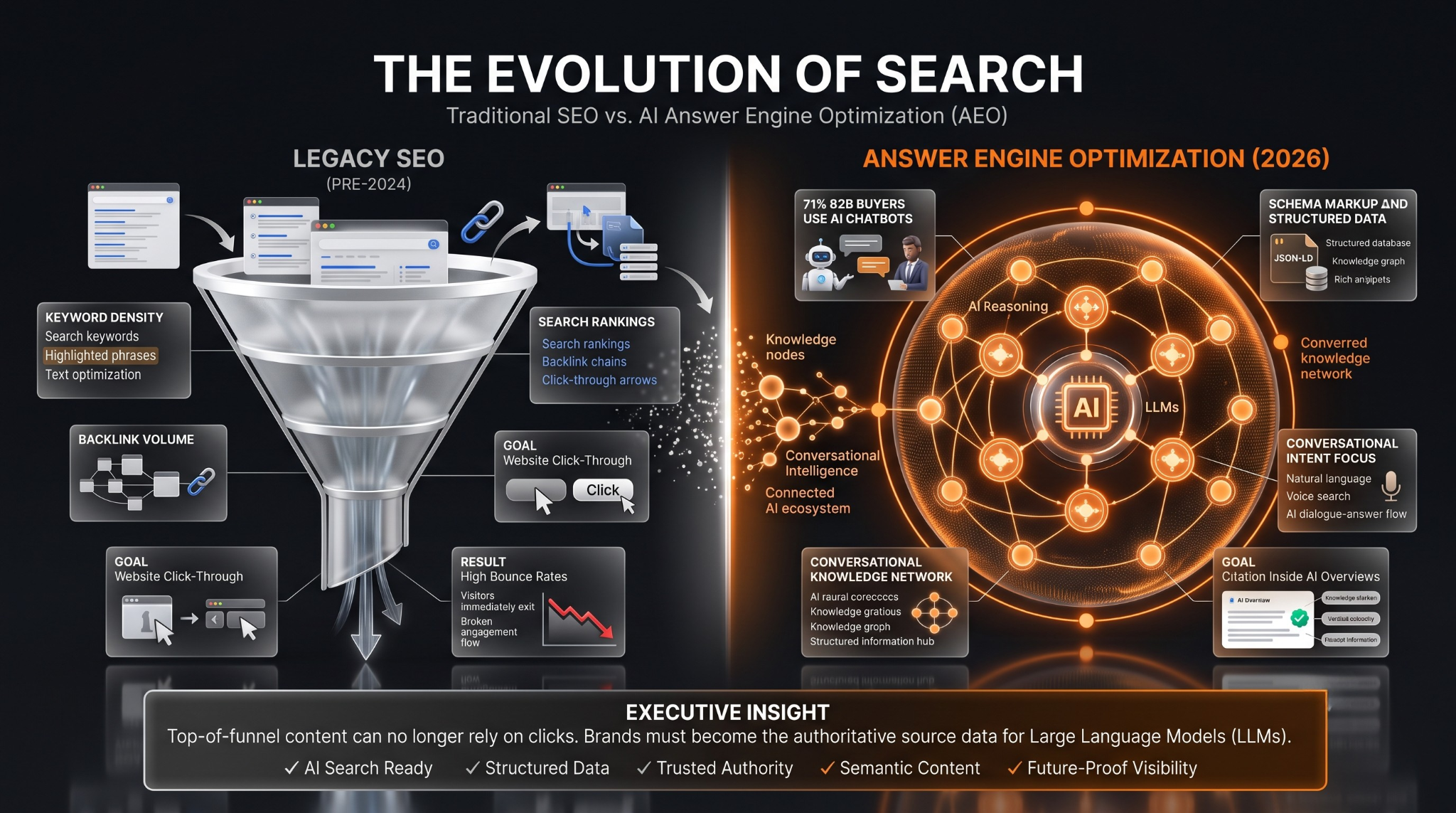
Perhaps the most disruptive change in 2026 is the transformation of the search landscape. Traditional Search Engine Optimization (SEO) relied on optimizing keywords to generate blue links that users would click3. Today, generative AI has intercepted the user journey.
Google’s AI Overviews now appear on 47% of all informational queries in India19. Furthermore, platforms like ChatGPT serve over 4 billion monthly searches globally, and Perplexity processes over 18 million daily queries in India alone19. Consequently, 71% of B2B decision-makers now report relying on AI chatbots for software research during their buying journey20.
Answer Engine Optimization (AEO) is not “future SEO”; it is a parallel, mandatory infrastructure19. Because users receive complete answers directly within the AI interface (zero-click searches), traditional click-through rates for top-of-funnel content are plummeting19. Brands must now optimize their digital presence to be cited inside the AI-generated answer. This requires meticulous structured data discipline, the implementation of conversational FAQ schema on every page, and the creation of authoritative, answer-style content19.
Privacy-First Marketing: Solving the Multi-Platform Attribution Crisis
The global regulatory environment—encompassing GDPR, CCPA, and India’s Digital Personal Data Protection (DPDP) Act—has systematically dismantled surveillance-style marketing9. The depreciation of third-party cookies, combined with browser tracking restrictions (such as iOS 14.5+), has resulted in catastrophic signal loss for brands still relying on outdated tracking mechanisms22.
The Siloed Platform Problem
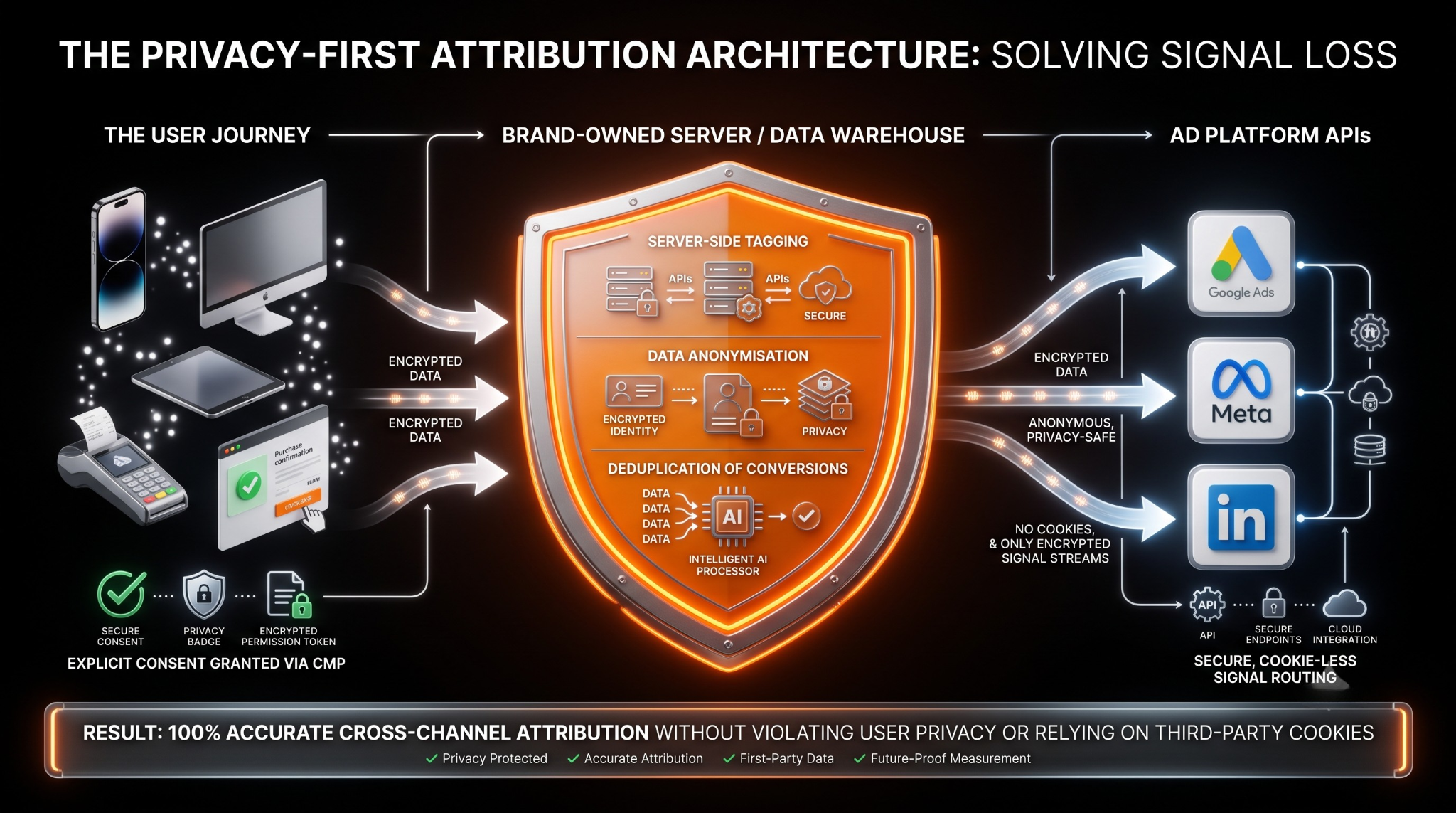
Historically, digital marketing attribution was fundamentally broken due to platform silos24. Consider this common scenario: A prospect clicks a Google ad on Monday, views a LinkedIn sponsored post on Wednesday, and finally clicks a Meta (Facebook) retargeting ad on Friday to make a purchase. Because each platform utilizes its own proprietary tracking pixel independently, Google, LinkedIn, and Meta will all claim 100% credit for that single conversion24.
This results in wildly inflated reporting. A brand’s CRM might show 50 actual new customers, but the combined ad platforms report 180 conversions24. Business owners making budget decisions based on these fragmented dashboards will inevitably scale inefficient campaigns and prematurely kill slow-burning, high-value channels24.
The Four Pillars of Modern Attribution
To survive in the age of consent and context, brands must construct a privacy-first attribution architecture9. Modern measurement relies on four integrated pillars22:
- Server-Side Tagging: Instead of relying on vulnerable browser-based pixels, server-side tagging routes user data first to a secure, brand-owned server22. The brand then controls exactly what anonymized data is forwarded to the ad platforms via APIs. This ensures strict data minimization, prevents ad blockers from disrupting tracking, and guarantees compliance with privacy laws22.
- Centralized Data Warehousing: Modern attribution requires an owned data foundation. By extracting data from isolated ad platforms and consolidating it within a secure data warehouse, brands can apply custom attribution models (e.g., linear, time-decay, or data-driven algorithmic attribution) to see the true, deduplicated customer journey23.
- Consent Management Platforms (CMPs): Consent is no longer merely a compliance checkbox; it is a fundamental design constraint9. CMPs ensure that tracking only occurs after explicit, unambiguous opt-in, maintaining a transparent value exchange between the brand and the consumer22.
- Offline Conversion Tracking: As customer journeys span digital and physical touchpoints, connecting online ad exposure to offline sales (via CRM integration) is critical for completing the attribution loop23.
B2B SaaS Unit Economics: The Science of CAC, LTV, and Payback
While B2C performance marketing often focuses on immediate transaction velocity, B2B marketing operates on a vastly different paradigm. In B2B SaaS (Software as a Service), performance marketing is evaluated strictly through the lens of complex unit economics: Customer Acquisition Cost (CAC), Customer Lifetime Value (LTV), and Payback Periods20.
The Realities of Customer Acquisition Cost (CAC)
The cost to acquire a B2B customer has surged by over 60% in the past five years, driven by rising ad costs (LinkedIn CPLs up 24% YoY), digital saturation, and extended, consensus-driven sales cycles20. However, looking at a single “average” CAC is highly misleading without contextualizing the specific Go-To-Market (GTM) motion20.
A self-serve Product-Led Growth (PLG) model might post a highly efficient CAC of under $700, relying on free trials and viral loops20. Conversely, a field-sales enterprise motion routinely incurs CACs ranging from $5,000 to $14,000+ per customer due to the necessity of Account-Based Marketing (ABM), extensive lead nurturing, and high-touch sales teams20.
Table 2: Median B2B SaaS CAC by Industry Vertical (2026)
Industry Vertical | Median CAC | Standard Range | Acquisition Strategy Focus |
|---|---|---|---|
Developer Tools | $380 | $200 – $600 | Organic SEO, Community Forums, Open-Source |
HR Tech | $450 | $250 – $700 | LinkedIn Lead Gen, Content Marketing |
MarTech | $520 | $300 – $900 | Paid Search (High Intent), Webinars |
HealthTech | $890 | $500 – $1,400 | Compliance-driven Content, Targeted ABM |
Cybersecurity | $1,100 | $600 – $1,800 | Thought Leadership, PR, Enterprise Sales |
FinTech | $1,461 | $800 – $2,500 | High-trust channels, Deep Nurture Funnels |
Data aggregated from 2026 B2B SaaS benchmarks27. Organic channels consistently out-perform paid channels regarding long-term CAC efficiency.
The LTV:CAC Ratio and the Importance of Payback Periods
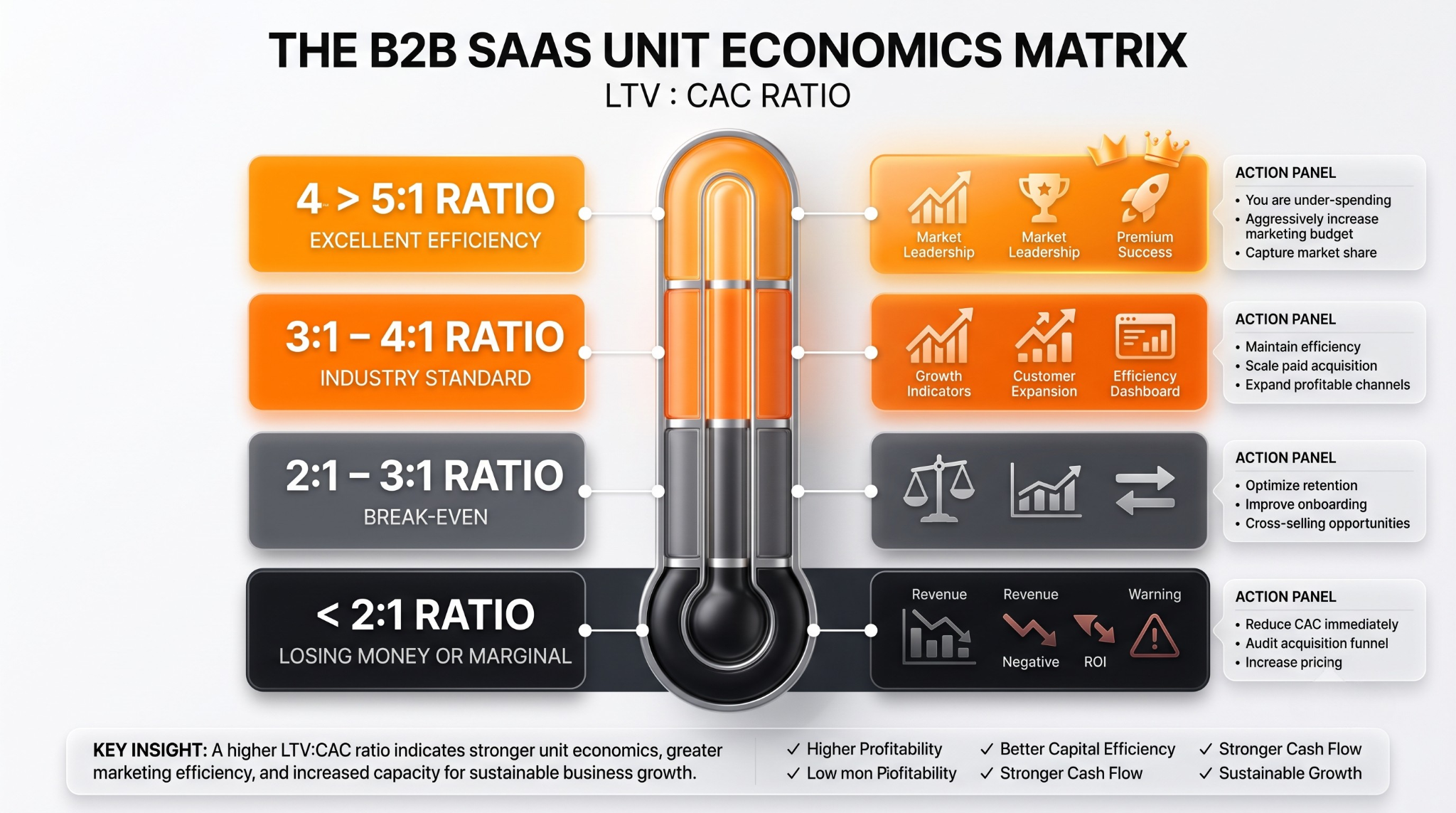
The ultimate metric of scalable, sustainable growth in B2B marketing is the LTV: CAC ratio. This quantifies the efficiency of your go-to-market strategy by comparing the total gross margin a customer generates over their lifespan against the cost required to acquire them25.
- The Baseline Target: A ratio of 3:1 is the widely accepted minimum benchmark for healthy growth. A median across B2B SaaS in 2026 stands at approximately 3.2:126.
- Elite Efficiency: Companies operating at ratios of 4:1 to 5:1 demonstrate scale-ready unit economics, characterized by highly optimized acquisition channels (like competitor conquesting) and exceptional customer retention27.
- The Danger Zone: Ratios below 2:1 indicate that a company is burning cash unprofitably on acquisition. This requires immediate intervention to either reduce marketing spend, optimize the sales funnel, or increase product pricing27.
However, for cash-constrained startups and scale-ups, theoretical Lifetime Value can be a dangerous metric if it takes too long to realize. Therefore, the Payback Period (the time it takes to recoup the initial CAC) is often the most critical health indicator25.
- SMB Payback Target: < 12 months.
- Mid-Market Payback Target: < 18 months.
- Enterprise Payback Target: < 24 months26.
Full-Funnel Performance Optimization: The Four-Stage Architecture
The most sophisticated performance marketing entities recognize that customer acquisition is not a single, discrete event; it is a multi-staged, highly nuanced journey3. Relying exclusively on bottom-of-the-funnel (BOF) direct-response advertisements inevitably leads to audience exhaustion and rapidly escalating acquisition costs17.
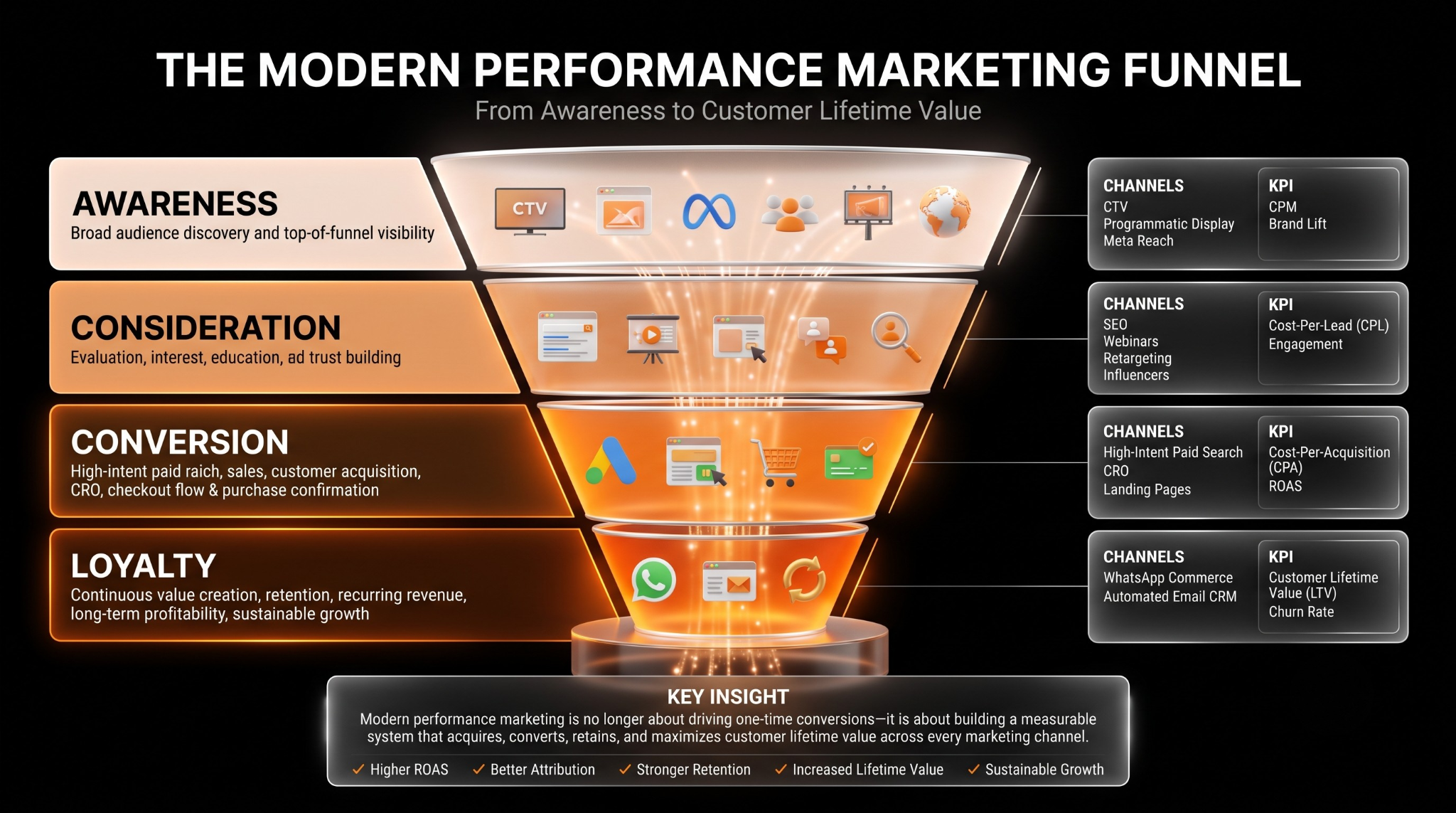
To engineer sustainable growth, brands must adopt a comprehensive, four-stage full-funnel architecture17:
1. Awareness (Top of Funnel)
The primary objective here is to establish brand familiarity and capture attention before the consumer has explicitly recognized a need17. In 2026, this is efficiently achieved through high-reach, upper-funnel channels such as programmatic Display, Digital Out-of-Home (DOOH), and Connected TV (CTV)4. Success at this stage is not measured by immediate sales, but by impression volume, Cost-Per-Mille (CPM), and subsequent lifts in branded search volume17.
2. Consideration (Middle of Funnel)
Once a consumer recognizes a pain point, they begin evaluating alternatives17. Performance tactics in the consideration phase involve educating the prospect. High-value lead magnets, gated whitepapers, customer case studies, and webinars (which yield a massive 213% average ROI in B2B) are deployed here17. Retargeting pixels and mid-funnel SEO strategies (e.g., targeting “[Competitor] Alternatives” keywords) are critical for capturing this warming intent20.
3. Conversion (Bottom of Funnel)
This is the transactional nexus. The focus shifts entirely to direct acquisition. Paid search campaigns on Google Ads targeting extreme high-intent keywords (e.g., “Buy [Product] Online” or “[Software] Pricing”) dominate this stage17.
However, driving high-intent traffic is financially ruinous if the destination fails to convert. Conversion Rate Optimization (CRO) is paramount. With average B2B website conversion rates hovering between 2% and 3%27, performance marketers must conduct relentless multivariable testing of landing page elements—headline copy, trust signals, page load speed, and frictionless form design16. A fractional improvement in landing page conversion from 2% to 3% effectively slashes your overall Cost Per Acquisition by 33%25.
4. Loyalty and Expansion (Post-Purchase)
The funnel does not end at the transaction. Post-purchase marketing drives retention and maximizes Customer Lifetime Value (CLTV), which is essential for maintaining healthy LTV:CAC ratios25. Performance teams leverage first-party CRM data to trigger automated email sequences, SMS alerts, and highly personalized WhatsApp cross-sell campaigns2.
Creative Velocity: Winning the Attention Economy
In a hyper-fragmented digital ecosystem saturated with content, technical media buying and perfect attribution are useless without compelling creative assets4. Performance marketing success in 2026 relies heavily on mastering high-velocity, format-specific creative.
The Dominance of Short-Form Video
Short-form video is no longer a peripheral brand-building tactic; it is the absolute primary performance asset2. Video advertisements on platforms like Instagram Reels, YouTube Shorts, and regional Indian applications (such as Moj) routinely deliver 20% to 30% higher conversion rates compared to static imagery4.
The average Gen-Z user in India now consumes 2.4 hours of short-form video daily19. Ad platform algorithms inherently prioritize motion content, and CPM rates for formats like Reels remain highly competitive19. Elite performance marketing teams operate video-first creative pipelines, iterating rapidly on user-generated content (UGC), direct problem-solution demonstrations, and dynamic, price-anchored value propositions2. If a brand’s social ad calendar is still 70% static graphics, they are severely under-investing in the formats that actually drive conversions19.
Regional Language Personalization at Scale
As India’s digital expansion penetrates deeply into Tier-2 and Tier-3 markets, regional language advertising has transitioned from a niche strategy to a critical revenue driver. Revenue contributions from these demographics jumped to 31% for D2C brands by early 202619.
Brands that ignore non-English advertisements are leaving up to 40% of their addressable market unmonetized19. Leveraging AI tools (such as Meta’s Advantage+ creative generators), brands can now seamlessly produce localized ad copy and regional voiceovers at scale. Campaigns utilizing dual-language hero copy and culturally synchronized messaging (e.g., aligning product pushes with regional festivals like Onam or Durga Puja) yield significantly higher engagement and lower customer acquisition costs4.
The Shift: WhatsApp Commerce Overtaking Email
While email remains a highly effective owned channel—particularly in B2B contexts where it can deliver up to a 261% ROI27—consumer-facing (D2C) brands in India are aggressively shifting lifecycle marketing budgets toward WhatsApp19.
Following strategic cost reductions for the WhatsApp Business API and the massive rollout of WhatsApp Pay, brands are executing seamless, end-to-end commerce directly within the chat interface19. WhatsApp campaigns currently boast open rates of 38% (compared to a mere 4-7% for standard promotional email)19. Furthermore, data indicates that cart abandonment recovery via WhatsApp converts at an astonishing 9-14%, vastly outperforming traditional email recovery mechanisms19.
The Agency Landscape: Why DigiLink Technologies is Your 2026 Growth Partner
As the digital ecosystem becomes exponentially more complex—demanding deep expertise in AI automation, server-side tracking infrastructure, algorithmic bidding, and high-velocity video production—brands are increasingly pivoting away from isolated, in-house execution1. The sheer technical requirements of modern marketing necessitate partnering with an integrated, full-service digital agency1.
Mumbai, as India’s commercial epicenter, hosts a highly competitive landscape of digital agencies16. However, the defining characteristic of a top-tier performance marketing agency in 2026 is the total abandonment of vanity metrics in favor of uncompromising revenue intelligence and ROI accountability30.
At DigiLink Technologies, based in Kandivali, Mumbai, we are engineered exactly for this reality. We do not just provide digital marketing services; we combine data-backed precision with elite creativity to build digital experiences that deliver measurable, scalable revenue growth6.
Our core capabilities perfectly align with the demands of the 2026 marketplace:
- Google-Certified Performance Marketing: We execute highly profitable Pay-Per-Click (PPC), Google Ads, and Meta advertising campaigns focused strictly on lead generation, Customer Acquisition Cost (CAC) reduction, and maximum ROAS6.
- AI-Powered Personalization & AEO: We go beyond traditional SEO. Our strategies encompass cutting-edge Answer Engine Optimization (AEO) and AI-driven hyper-personalization, ensuring your brand intercepts high-intent buyers across all emerging search formats6.
- Conversion-Optimized Web Development: Driving traffic is useless if your site cannot close the deal. We design mobile-first, lightning-fast, and UX-optimized websites built specifically with Conversion Rate Optimization (CRO) architecture to turn visitors into loyal customers6.
- Radical Transparency: We believe your success is our only metric. We operate with complete transparency, providing real-time analytics and tracking every rupee invested directly back to tangible business outcomes7.
Conclusion: Engineering Sustainable, Data-Driven Growth
The era of simplistic, surveillance-style digital marketing has unequivocally ended9. Performance marketing in 2026 is a highly sophisticated, deeply technical discipline that merges behavioral economics, artificial intelligence, strict privacy compliance, and rigorous creative testing2.
To thrive in the expanding Indian digital market, brands must navigate a fragmented ecosystem where consumer attention is bifurcated across Connected TV, quick commerce apps, and localized short-form video12. Organizations must prioritize the establishment of owned, privacy-first data infrastructures, transitioning away from siloed platform metrics toward holistic, server-side data warehousing22.
Furthermore, businesses must master the underlying unit economics of their specific models—maintaining strict vigilance over CAC, LTV:CAC ratios, and Payback Periods—to ensure that marketing investments compound into sustainable enterprise value26.
Success ultimately belongs to the organizations that treat data as a strategic asset, respect consumer consent, and partner with elite agencies capable of seamlessly integrating algorithmic automation with compelling human creativity2.
Are you ready to dominate your market in 2026? Contact DigiLink Technologies today for a free consultation, and let us architect your digital growth engine.
Works cited
Top Digital Marketing Trends 2026 | Experience Commerce Mumbai, https://www.experiencecommerce.com/blog/digital-marketing-trends-2026-experience-commerce-Mumbai-Agency
Performance Marketing Trends 2026: What Brands Must Do Next – Ideamagix, https://www.ideamagix.com/blog/performance-marketing-trends-2026/
the_online_advertising_playbook__proven_strategies_and_tested_tactics_from_the_advertising_research_foundation.pdf
Performance Marketing Trends for Indian Brands in 2026 | Webenza, https://www.webenza.com/blog/performance-marketing-trends-indian-brands/
What Is Performance Marketing? 2026 Guide, https://etmarkacademy.com/what-is-performance-marketing-why-in-demand/
Digital Marketing Agency in Mumbai | Grow Your Leads-DigiLink Technologies, https://digilinktech.in/
Performance Marketing: Ultimate Growth Strategy in 2026, https://digilinktech.in/performance-marketing-growth-strategy-2026/
DigiLink Technologies – Services & Company Info – Clutch, https://clutch.co/profile/digilink-technologies-0
Privacy First Performance: Marketing in the Age of Consent and Context – MarTech Breakthrough Awards, https://martechbreakthrough.com/privacy-first-performance-marketing-in-the-age-of-consent-and-context/
Digital becomes India’s largest ad channel in 2025 to take 70% adex share by 2027: Dentsu Report – Social Samosa, https://www.socialsamosa.com/report/digital-becomes-indias-largest-ad-channel-dentsu-report-11067359
Digital Marketing in India: Spend, ROI & Strategy Outlook for 2026 | by Haemoglobbinn, https://medium.com/@shriswamisamrthmarketing/digital-marketing-in-india-spend-roi-strategy-outlook-for-2026-62cf72f5bc23
India’s Ad Market Hits ₹1.55 Lakh Crore: Digital Now 60% – WrittenlyHub, https://www.writtenlyhub.com/news/india-advertising-market-2026-pmar-digital
India’s digital ad market to reach $14.6 billion in 2026 as brands diversify spending, https://indiantelevision.com/mam/indias-digital-ad-market-to-reach-14-6-billion-in-2026-as-brands-diversify-spending/
India’s Digital Advertising in 2026: 5 Shifts Marketers Can’t Ignore – DAIOM, https://daiom.in/indias-digital-advertising-in-2026-5-shifts-marketers-cant-ignore-blog/
Privacy-first marketing: thrive beyond cookies and compliance – Data Axle, https://www.data-axle.com/resources/blog/privacy-first-marketing-beyond-cookies-compliance/
Top Digital Marketing Trends in Mumbai (2026) | Stay Ahead – GBIM, https://www.gbim.com/blog/top-digital-marketing-trends-shaping-mumbai-businesses-in-2026/
What is a Marketing Funnel? How They Work, Stages & Examples | Amazon Ads, https://advertising.amazon.com/library/guides/marketing-funnel
The Best Social Media Marketing Companies in India – Apr 2026 | The Manifest, https://themanifest.com/in/social-media/agencies?page=201
Top 10 Digital Marketing Trends in India for 2026 (Data-Backed) – Lenoretech, https://www.lenoretech.in/blog/digital-marketing-trends-india-2026.html
B2B SaaS Marketing Statistics (2026): Data Points on CAC, Pipeline, Conversion Rates, and AI Adoption – Omnibound, https://www.omnibound.ai/blog/b2b-saas-marketing-statistics
Top 10 SEO Marketing Agencies in Mumbai (2026 Edition) – Reddit, https://www.reddit.com/r/AiDigital_Marketing/comments/1tavqo7/top_10_seo_marketing_agencies_in_mumbai_2026/
Privacy-First Marketing: Complete Guide for 2025, https://secureprivacy.ai/blog/privacy-first-marketing-guide-2025-strategies-tools
Modernizing Marketing Attribution in a Privacy-First World – ROI Revolution, https://roirevolution.com/blog/modernizing-marketing-attribution-in-a-privacy-first-world/
Performance Marketing Attribution: Complete Guide 2026 – Cometly, https://www.cometly.com/post/performance-marketing-attribution-complete-guide
B2B Customer Acquisition Cost Insights: How to Cut CAC in 2026 – Martal Group, https://martal.ca/b2b-customer-acquisition-cost-lb/
B2B SaaS LTV Benchmarks — 939 Companies by Segment & LTV:CAC Ratio | Optifai, https://optif.ai/learn/questions/b2b-saas-ltv-benchmark/
Latest B2B Marketing Benchmarks 2026: CAC, ROI, Conversion Stats | Konabayev, https://konabayev.com/blog/b2b-marketing-benchmarks-2026/
Average Customer Acquisition Cost (CAC) By Industry: B2B Edition – First Page Sage, https://firstpagesage.com/reports/average-customer-acquisition-cost-cac-by-industry-b2b-edition-fc/
Best LTV to CAC Ratio Benchmarks for B2B SaaS in 2026, https://www.saashero.net/strategy/b2b-saas-ltv-cac-benchmarks/
Best Performance Marketing Agency in India 2026, https://ashokkumardigital.in/performance-marketing-agency-in-india/
Top 10 Performance Marketing Agencies in Mumbai (2026) – GoCodex, https://gocodex.com/blog/top-10-performance-marketing-agencies-in-mumbai/
11 Best Performance Marketing Agencies in Mumbai (2026), https://whyysoserious.in/best-performance-marketing-agencies-in-mumbai/
Top 10 Performance Marketing Agencies In Mumbai Worth Hiring In 2026 – Codexxa, https://codexxa.net/blog/top-performance-marketing-agencies-in-mumbai/
Digital Marketing Company in Mumbai | Trusted Experts – DigiLink Technologies, https://digilinktech.in/about-us/
Digital Marketing Agency Near Me | Free Consultation – DigiLink Technologies, https://digilinktech.in/contact-us/
AI-Based Personalization in Digital Marketing 2026 | DigiLink Technologies, https://digilinktech.in/ai-based-personalization-digital-marketing-2026/
Digilink Technologies in Vasant Nagari-Vasai East, Palghar – Best Digital Marketing Services in Palghar – Justdial, https://www.justdial.com/jdmart/Mumbai/Digilink-Technologies-Opposite-Fire-Brigade-Vasant-Nagari-Vasai-East/022PXX22-XX22-230803163538-X9I9_BZDET/catalogue?nid=12099539